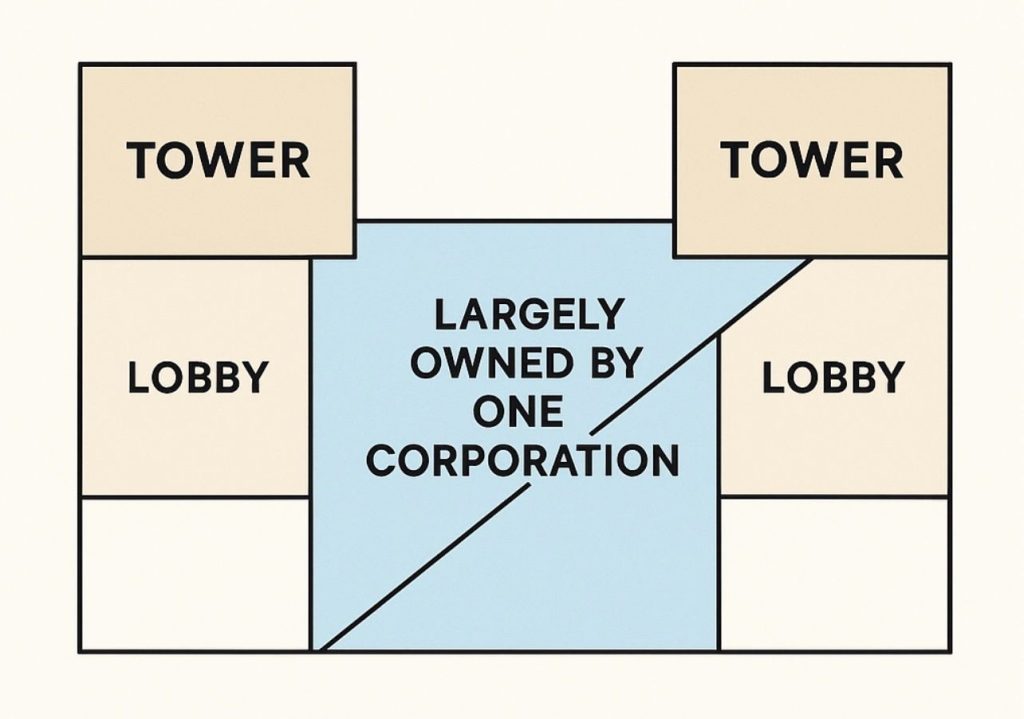
It started as a straightforward refurbishment project: two towers, each with its own lobby, connected through a shared front entrance and a central space that joined them. On paper, it appeared seamless—one continuous environment shared by both communities. The project was tendered as a single unit. However, once awarded, we were asked to divide the scope into three distinct phases: one for each tower and a third for the shared facility.
That is when the boundaries began to blur. Without clearly defined physical limits, we were unable to split the costs accurately. No one could confirm exactly where one building’s ownership ended and the other’s began.
Vague Agreements: The reciprocal agreements between the corporations described shared responsibilities in general terms but never established the physical limits of the space.
Assumed Equality: For years, everyone had operated under the assumption that the entire area was shared equally. This worked quietly and without issue—until the refurbishment forced a closer look.
Once legal counsel was engaged to establish the legal boundaries, it became clear that what had been treated as a common area was, in fact, largely owned by one corporation. That discovery changed everything.
Design Division: Practical details—flooring transitions, wall treatments, and lighting layouts—had to be divided carefully to reflect ownership lines that no one had realized existed.
Reciprocal Imbalance: Across many high-rise developments, agreements drafted decades ago lacked precision. Some boundaries were never defined; others were defined in ways that no longer make sense.
The law assumes that each corporation knows exactly what it owns, maintains, and controls. In practice, that clarity often fades over time. Refurbishment has a way of uncovering what governance overlooks.

Governance gaps shouldn’t derail your building’s aesthetic future. At Congruent Build, we specialize in the technical and legal complexities of Condo Renovation Toronto. As an expert Toronto General Contractor, we ensure that even the most complex shared-facility projects are executed with total clarity and financial precision.